
A clinic can have excellent doctors and still feel painfully disorganized. That sounds harsh, but every busy practice knows the feeling. The waiting area fills up. The phone keeps ringing. A patient asks about a follow-up nobody logged properly. Someone searches for an old prescription inside a chat thread. And suddenly, the clinic day is not being managed. It is being survived.
For many Philippine clinics, the real bottleneck is not care quality. It is the workflow behind the care. Scheduling, documentation, prescriptions, patient history, follow-ups, and teleconsult records all need to move together. When they do not, even simple tasks start acting like tiny emergencies wearing comfortable shoes.
That is why EMR workflows for Philippine clinics deserve a serious conversation. Not a flashy one. A practical one.
EMR Workflows Are Where Clinic Chaos Starts Behaving
Let’s be honest, manual clinic systems often begin with good intentions. A spreadsheet here. A notebook there. A messaging app for reminders. A folder for prescriptions. It works at first. Then patient volume grows, the clinic adds teleconsults, and everyone starts quietly wondering who last updated the record.
That is the exact kind of mess behind many clinic reception workflow problems. Front desk teams are not failing because they are careless. They are juggling too many disconnected tools while patients expect faster coordination.
A cleaner clinic workflow EMR brings the moving parts into one place. Appointments become easier to check. Patient profiles are easier to retrieve. Follow-up notes do not disappear into the digital wilderness. Small thing? Not really. That little bit of order can change the entire mood of the clinic.
Clinic Follow Up Management Is Not a Side Task
Follow-ups are where patient relationships are either strengthened or slowly lost. A patient is told to come back in two weeks. No one logs it properly. The clinic gets busy. The patient forgets. The care plan quietly stalls.
That is why clinic follow up management matters so much. It is not just an admin feature. It is part of continuity of care.
Patients notice when clinics remember them. They also notice when every visit feels like starting from zero. Awkward? Very.
How Do EMR Workflows Help Clinics Keep Patients Returning
A practical EMR patient follow-up system helps teams track repeat visits, reminders, consultation notes, and patient histories without depending on memory alone. The point is not to make the clinic feel high-tech for show. The point is to make care easier to continue.
This is where understanding why small clinics lose follow-ups becomes useful. Many patients do not vanish because they dislike the doctor. They disappear because the clinic has no reliable rhythm for bringing them back.
And if your clinic still depends on spreadsheet trackers, the smarter move is to organize repeat patient visits without spreadsheet tracking. Because one accidental deleted cell should not ruin the afternoon. We have all seen that movie.
Digital Prescriptions and Patient Records Should Travel Together
A prescription is not just a piece of paper. It is part of the patient story. What was given? When? Was it adjusted later? Was it connected to a follow-up? If the answer lives in three separate places, the next consultation becomes harder than it should be.
That is why digital prescription workflows for Philippine clinics are becoming more important. Printable records help patients. Linked prescription histories help doctors. Organized files help staff breathe a little easier.
The best workflow is not the one with the fanciest screen. It is the one that lets a doctor review history, write notes, generate a prescription, and keep everything attached to the patient record without switching tools every thirty seconds.
Simple. Useful. Slightly magical when the old system was chaos.
Clinic Scheduling Software Philippines Practices Can Actually Use
Manual scheduling has a way of pretending to be harmless. One paper logbook. One spreadsheet. A few chat reminders. Then suddenly there are double bookings, missed follow-ups, forgotten reschedules, and a receptionist whispering “hala” under their breath.
That is the hidden cost of manual clinic scheduling. It costs time, patience, revenue opportunities, and trust. Not always loudly. Usually in tiny leaks that become normal.
A practical clinic scheduling software Philippines setup should support physical consultations, teleconsult appointments, follow-up visits, patient reminders, and daily schedule visibility. Not in six different tabs. Not in a spreadsheet named “FINAL updated v3.” One connected workflow.
Because once scheduling becomes calmer, the whole clinic feels calmer.
PhilHealth Ready EMR and YAKAP Ready Workflows Need Cleaner Documentation
Documentation readiness is not just about having records somewhere. “Somewhere” is not a strategy. A clinic needs patient demographics, consultation notes, prescriptions, encounter histories, follow-up records, and teleconsult details organized clearly enough to support daily operations.
That is the practical meaning behind PhilHealth-ready EMR workflows. It is about cleaner structure, not decorative digitization.
What Does Documentation Ready Mean for a Small Clinic
For a small clinic, documentation-ready means staff can find what they need without detective work. Doctors can review patient history without asking the same questions again. Follow-ups stay visible. Prescriptions remain tied to visits. Teleconsult records do not float separately from in-person care.
As clinics prepare for evolving healthcare workflows, many are also looking at how to transition to YAKAP-ready EMR workflows. The bigger lesson is clear enough, disconnected systems are becoming harder to defend.
For clinics still adjusting, learning why clinics are moving beyond eKonsulta can help frame the change less as a software switch and more as an operational upgrade.
Secure Audit Logs and Shared Patient Records Build Trust
Trust is not only built inside the consultation room. It is also built in how the clinic handles records when no one is watching.
A clinic needs to know who accessed a file, when a record was updated, and how documentation changes were handled. That is why secure audit logs matter. Not glamorous. Very useful when questions appear.
The same goes for shared patient records in multi-doctor clinics. Patients do not care which doctor saw them last. They expect the clinic to know their history. Fair enough.
When records are centralized and accessible to authorized users, care feels more coordinated. The patient does not have to retell the entire saga. The doctor does not waste time rebuilding the timeline. Everyone wins, including the front desk staff who no longer has to open four folders and pray.
This also helps close patient history gaps that can weaken continuity of care. Longitudinal records give clinics a clearer view of the patient journey, not just isolated visits.
A Smarter UltraVisit Workflow Feels Calm From the Front Desk to the Doctor
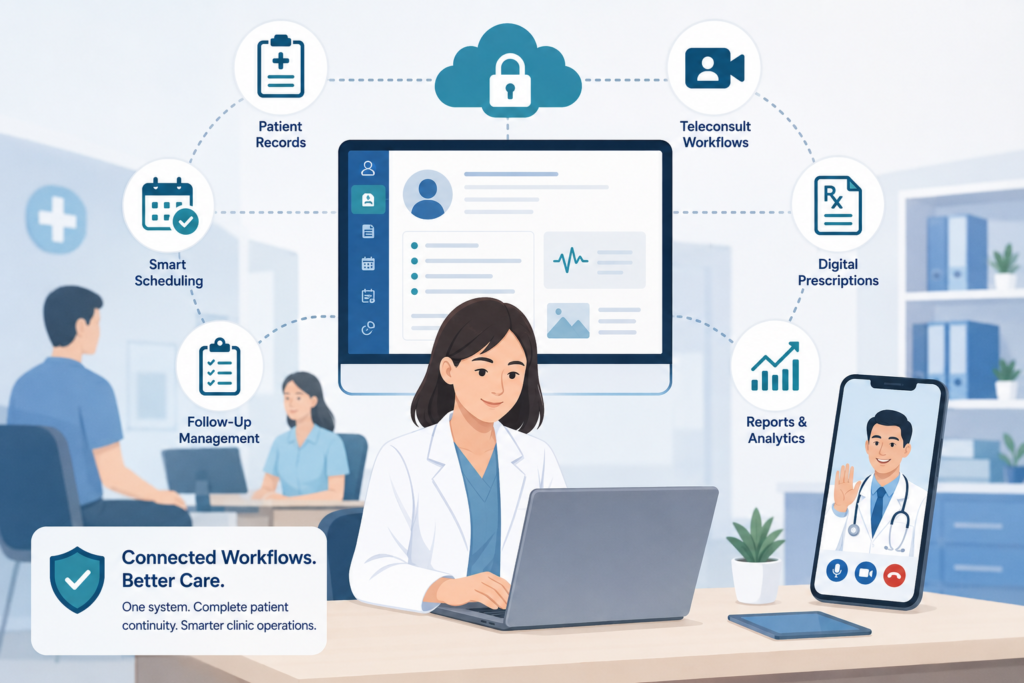
Good clinic technology should not feel like another job. It should remove friction from the jobs already happening. Scheduling. Follow-ups. Prescriptions. Patient histories. Teleconsult records. Documentation. Access visibility.
That is where UltraVisit fits naturally for clinics that want to modernize without turning daily operations into a complicated training seminar. The value is not just “going digital.” The value is helping the clinic feel more organized, more consistent, and less dependent on scattered manual systems.
And yes, patients feel that difference. They may not say, “Your EMR workflow is excellent.” Nobody talks like that in a waiting room. But they will notice when appointments are smoother, prescriptions are clearer, records are ready, and follow-ups do not feel forgotten.
That is the real win.
If your clinic is ready to improve EMR workflows, patient follow-ups, digital prescriptions, clinic scheduling, and documentation readiness, you can start the conversation with UltraVisit through the Contact Us page.